The Woman Who Sells Flowers Near the Canal, and Her Saturday Regulars
For years she has stood at the same spot by the Canal Saint-Martin. The people who come back every Saturday morning explain what a corner of a city can hold.
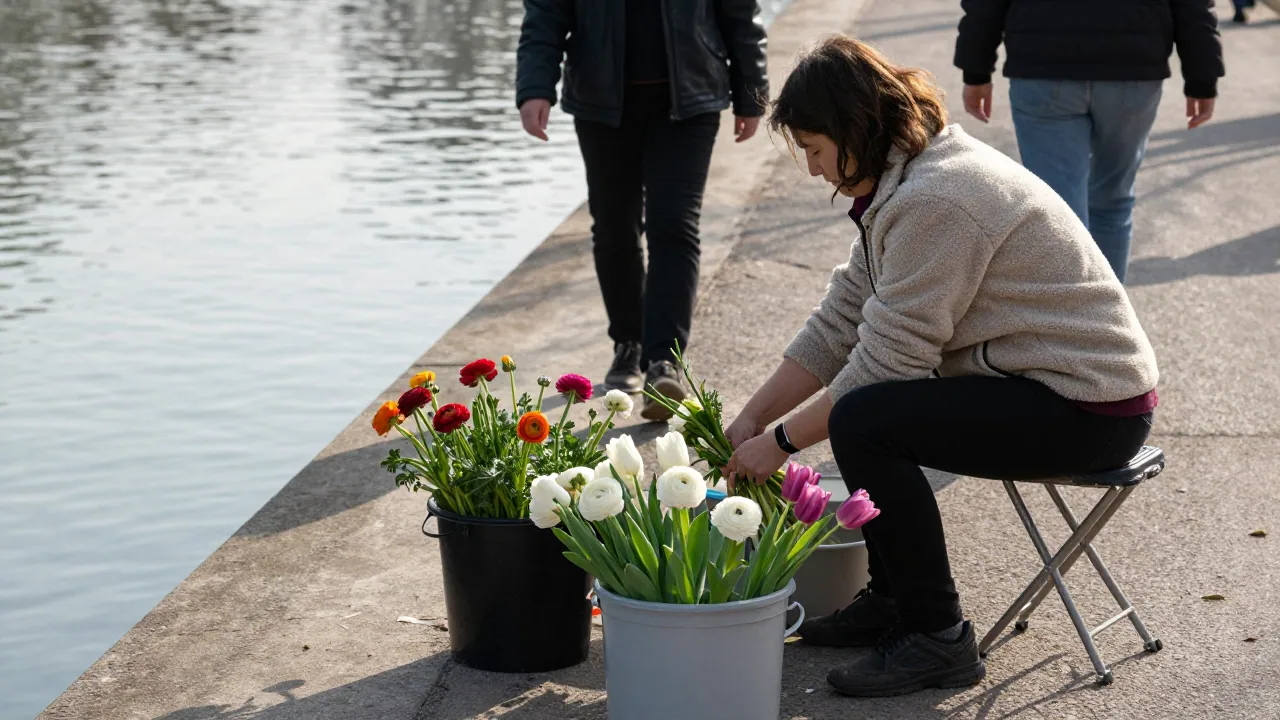
Saturday at eight, the canal is still grey and the market vans are unloading at the top of the street. By the water, a woman sets down two buckets of ranunculus and one of eucalyptus, arranges a folding stool, and waits. She has done this on the same stretch for years, and her customers have learned her rhythms the way you learn a bus timetable. The first one arrives before nine, an older man who buys three stems of the same thing every week and never asks the price. What follows is less a flower stall than a small weekly appointment, and it is the kind of thing we look for when we walk the market streets with our cameras.
We met her on a Saturday in early spring, on a morning when our photo walk had split up along the canal and I ended up alone at the water's edge, watching her wrap a bunch in newspaper. She did not mind the camera. She minded the cold. She kept her hands in her pockets between customers and told me, in a flat voice, that she has been on this stretch long enough to know which regulars will arrive in which order.
The order of a Saturday morning
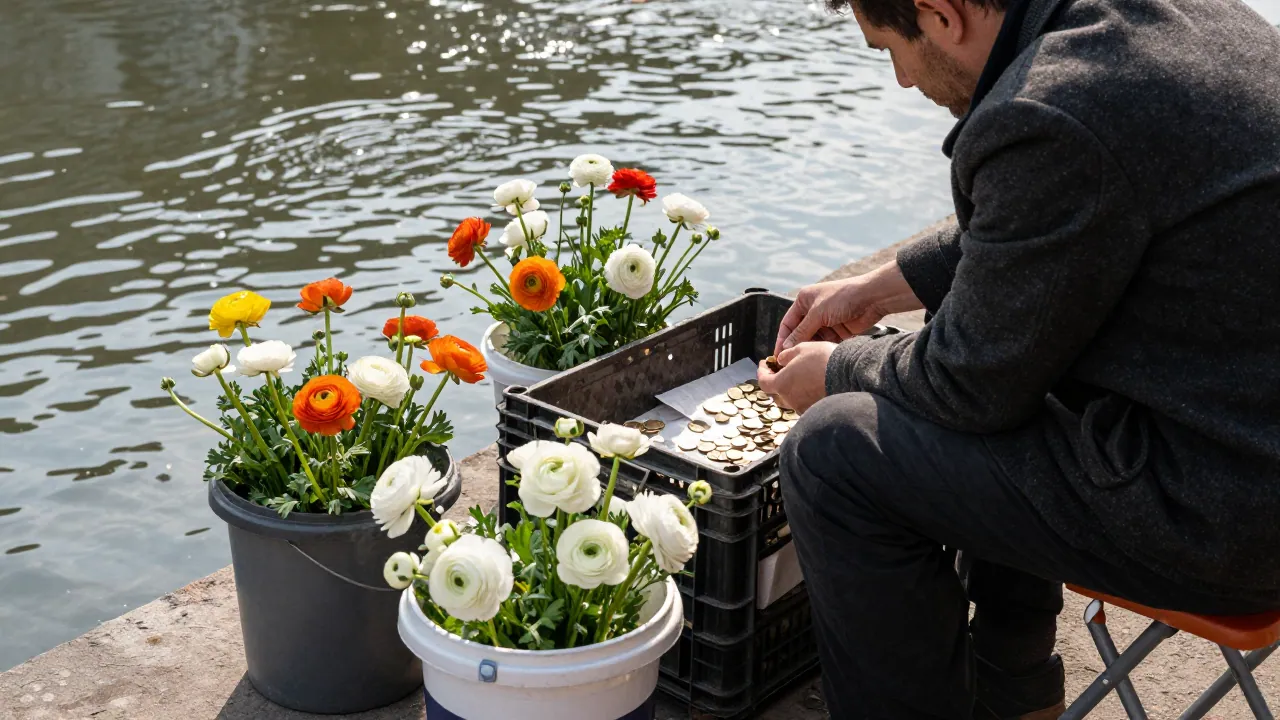
The older man comes first. Three stems, same variety, coins counted out on the upturned crate. Then a woman who runs a small café two streets away and buys whatever smells strongest that week, because, she says, the tables near the door get no light and need something alive. Then a young father with a child on his shoulders, who lets the child choose, which is why he usually leaves with something orange.
By half past nine there is a loose queue. Nobody organises it. It forms because people know roughly when to come and they do not want to miss the good buckets. This is the part we photograph most: not the flowers, but the waiting, the way people stand with their hands folded or lean over the buckets to check the stems.
What she notices from one spot
Standing still for four hours a week gives you a particular view of a street. She knows which delivery van parks badly, which building's shutters open first, which dog is walked at ten. She told us that the canal changes character three times in a morning, and that she can tell the hour by the sound of it.
People think I am watching the flowers. I am watching the street. The flowers are just why I am allowed to stand here.
It is the same lesson we keep relearning on our walks. A camera moves fast and misses things; a person who stays put learns a place. When we photographed the winter light on the long shopping street further north, the useful frames came after we had stood in one doorway for twenty minutes, not during the first pass. The flower seller does that every week without thinking of it as a method.
The regulars, briefly
| Who | When | What they buy |
|---|---|---|
| The older man in the wool coat | Before nine | Three stems of the same variety, coins on the crate |
| The café owner | Around nine | Whatever smells strongest that week |
| The father with the child | Half past nine | Something orange, chosen by the child |
| Two neighbours from the same building | Ten o'clock | One bunch split between them |
The two neighbours are the newest habit. They met in the queue last autumn, discovered they live in the same building, and now arrive together and split a bunch so neither has to buy a whole one. The seller finds this funny and slightly inconvenient, and she has started tying smaller bunches on Saturdays.
What we took away
Our own walks have changed because of mornings like this one. We used to arrive somewhere, shoot for an hour, and leave with a card full of strangers. Now we try to give one spot the whole session and let the repetition do the work. It is slower and it produces fewer pictures, and the ones we keep are better.
If you come out with us on a Saturday, you do not have to find a story like this one. You only have to pick a corner and stay in it long enough for something to happen twice. That is usually when it becomes worth photographing. The flower seller would put it more simply: the second time, you start to see it.
Questions people ask
Can I photograph the flower seller's stall?
Yes, from the public path and without blocking the queue. She is used to cameras and asks only that you do not stand between her and a customer mid-purchase. Ask before close portraits.
Which morning is best for this kind of scene?
Saturday, early. The canal is quiet before nine, the buckets are full, and the regulars arrive in a predictable order. By eleven the light is hard and the queue is gone.
Do I need a special camera for a slow morning like this?
No. A phone is fine, and many of our walk participants use one. What matters is staying in one place long enough to notice the repetition, not the equipment in your bag.